
 Peter Lazenby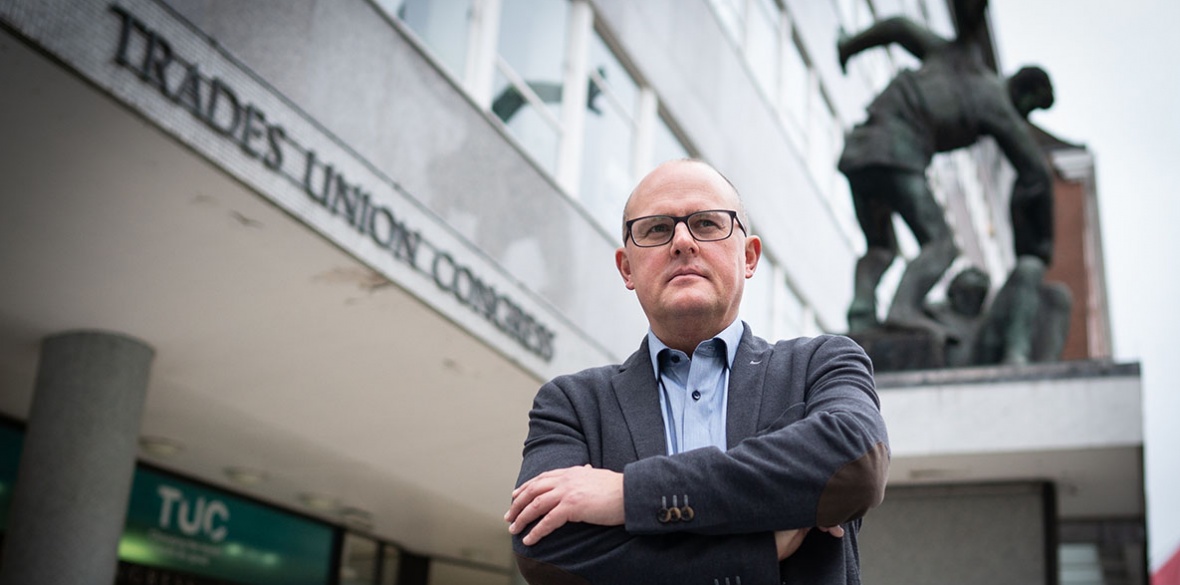

This is the last article you can read this month
You can read more article this month
You can read more articles this month
Sorry your limit is up for this month
Reset on:
Please help support the Morning Star by subscribing here
WORKERS’ strikes against the government’s decade-long attack on their living standards must be backed by a “bigger, stronger and more diverse” trade union movement, the incoming TUC general secretary declared today.
As tens of thousands of workers and their unions prepare to intensify their industrial action in the new year, Paul Nowak accused the government of “sabotaging” efforts to settle disputes raging in the health, rail, postal and Civil Service sectors.
He demanded the government and employers work with unions to “end Britain’s living standards nightmare.”
But he said workers have been “left with no choice” but to strike in the face of “two decades of lost pay.”
Mr Nowak made his first public declaration of his plans for a united, fighting trade union movement as he prepares to take over from Frances O’Grady as general secretary of the TUC when she stands down after nine years this weekend.
He condemned the appalling catalogue of government attacks on workers and their unions over the 12 years in which the Tories have been in power.
Mr Nowak said the attacks have left workers tens of thousands of pounds worse off and they have suffered scandals such as zero-hours contracts, casualisation and employers’ actions such as P&O’s sacking of its entire workforce without consequences.
And he accused the Tories of becoming “the P&O party” with their plans for yet more anti-union laws.
New TUC analysis reveals that workers in Britain have lost £20,000 in real wages on average since 2008 because of pay not keeping up with inflation — equal to £1,450 a year.
Mr Nowak said that in “the longest real wage squeeze in modern history,” nurses have lost £42,000 in real earnings since 2008 (£3,000 a year), midwives have lost £56,000 (£4,000 a year) and paramedics have lost £56,000 (£4,000 a year).
“And if the government does not improve its pay offer for public servants, public-sector pay will fall, on average, by over £100 a month in real terms in 2023,” he said.
In Mr Nowak’s first weeks in office, waves of strike action will hit Britain involving train drivers and other rail workers, nurses, midwives, teachers, ambulance workers, border control staff, driving examiners and other civil servants.
Firefighters are balloting on strike action and junior doctors are expected to do the same.
Mr Nowak said: “Nobody takes the decision to go on strike lightly.
“But this is a problem of the government’s own making. Twelve years of pay cuts have left workers with no choice.
“Nurses, teachers and other key workers have been forced into taking action to defend their livelihoods and the services they provide.
“All they want is a fair day’s pay and to be able to provide for their families.
“But rather than sitting down and negotiating in good faith with unions, ministers are sabotaging efforts to reach settlements.
“They are the ones who are behaving unreasonably — not the people taking the hard decision to withdraw their labour.”
Mr Nowak said the strikes could be avoided but that “the government must be willing to commit to meaningful talks about pay.”
He said that increasing union membership “is how the trade union movement wins the current wave of disputes — and turns the tide on casualisation and standstill wages” and warned “there will be no hiding place for P&O-style bosses.”
The new trade union leader promised “to build a trade union movement that represents the diversity of the modern working class.”
Downing Street said double-digit wage increases for public-sector workers would “embed inflation.”
But recent independent research for the TUC revealed that 60 per cent of today’s inflation rates are caused by profiteering.






